






Free written scope consultation - allowances, timeline, and change-order rules on paper before a single trade is scheduled
Styles & brands we work with
- Kitchen remodeling
- Bathroom remodeling
- Home additions & ADU
- Roofing
- Windows & doors
- Driveway & pavers
- Fence
See the difference
 Before
 After
 Before
 After
 Before
 After
How to Find a Roof Leak in Long Beach, CA: Trace the Water, Not the Stain
Finding a roof leak starts with one rule: follow the water uphill from the ceiling stain, not straight up from it. On a Long Beach bungalow, water routinely travels six to eight feet along roof decking before it finds a nail hole or seam to drip through, so the wet spot on your hallway ceiling is usually nowhere near the actual entry point. The real breach is almost always at a flashing joint, a stucco-to-roof transition, or an old addition seam. If water is coming in right now, call (888) 345-8164 and we’ll walk you through it in real time.
Key Takeaways
- Trace the stain uphill along the slope, not directly above the drip.
- On pre-1970 Long Beach homes, corroded step flashing at chimneys and dormers is the most common hidden source.
- A slow hose test at a flashing joint can confirm a leak in under 90 seconds.
- Termite galleries in the decking can mimic a roof leak; a moisture meter tells them apart before you tear off shingles.
- Un-permitted additions on fourplexes and bungalows hide a cold-joint seam where new roof meets old.

Why Long Beach Roofs Leak Differently Than Inland Roofs
Long Beach sits in a marine environment shaped by the port and the coastal air, and that salt-laden moisture corrodes exterior wood, stucco, and fasteners faster than you’ll see in Lakewood or Compton. Inland roofs mostly leak at failed shingles after a storm. Here, the leaks we chase most often start at metal: galvanized step flashing at chimney and dormer bases rusts through on homes built before 1970, and once that flashing is gone, water slips behind the stucco and shows up as a ceiling stain inside the house. The other local wrinkle is the housing stock itself. Rose Park and Belmont Heights are full of 1920s Spanish Colonial Revival and Craftsman bungalows, while the east side carries dense 1950s-70s stucco fourplexes. On the fourplexes, decades-old un-permitted additions created a cold-joint seam where the addition roof meets the original – a leak waiting to happen and the first place to look on any older multi-family building.
What to Look For: A Leak-Hunting Sequence That Beats the Attic Check
The standard advice is to climb into the attic and look for daylight. On this housing stock, that check misses most of the actual leaks, because salt-air corrosion and stucco transitions don’t show up as a gap you can see. Here’s the sequence that works in Long Beach, in the order to run it.
- Start with the stain, then move uphill. Note the drip point on the ceiling and trace back along the roof slope above and to the sides. On the low-slope sections of Spanish Colonial and Craftsman homes, water migrates laterally under the membrane before it breaches, so the entry point is often several feet away at a flashing joint or parapet transition.
- Inspect the metal before the shingles. Look hard at step flashing at chimney and dormer bases. On pre-1970 Long Beach homes, corroded galvanized flashing is the single most common hidden leak source – check for rust, gaps, and lifted edges where flashing meets the wall.
- Run the slow hose test. Have someone run a hose slowly over the suspect flashing joint while a second person watches the ceiling below. If a drip appears within 90 seconds, you found it. (Keep the water slow and steady – a blast can run past the joint and tell you nothing.)
- Check the addition seam. On bungalows and fourplexes with older additions, inspect where the addition roof ties into the original. That cold joint is often the culprit even when the visible roof above looks fine.
- Test before you tear off. If the leak seems to come from a termite-damaged area, reach for a moisture meter on the decking first. Termite galleries create paths for water by condensation and capillary action that look like active leaks but aren’t a surface breach – the meter distinguishes the two before any demolition.
Question and Answer: The Details That Decide the Fix
Do I need to get on the roof myself?
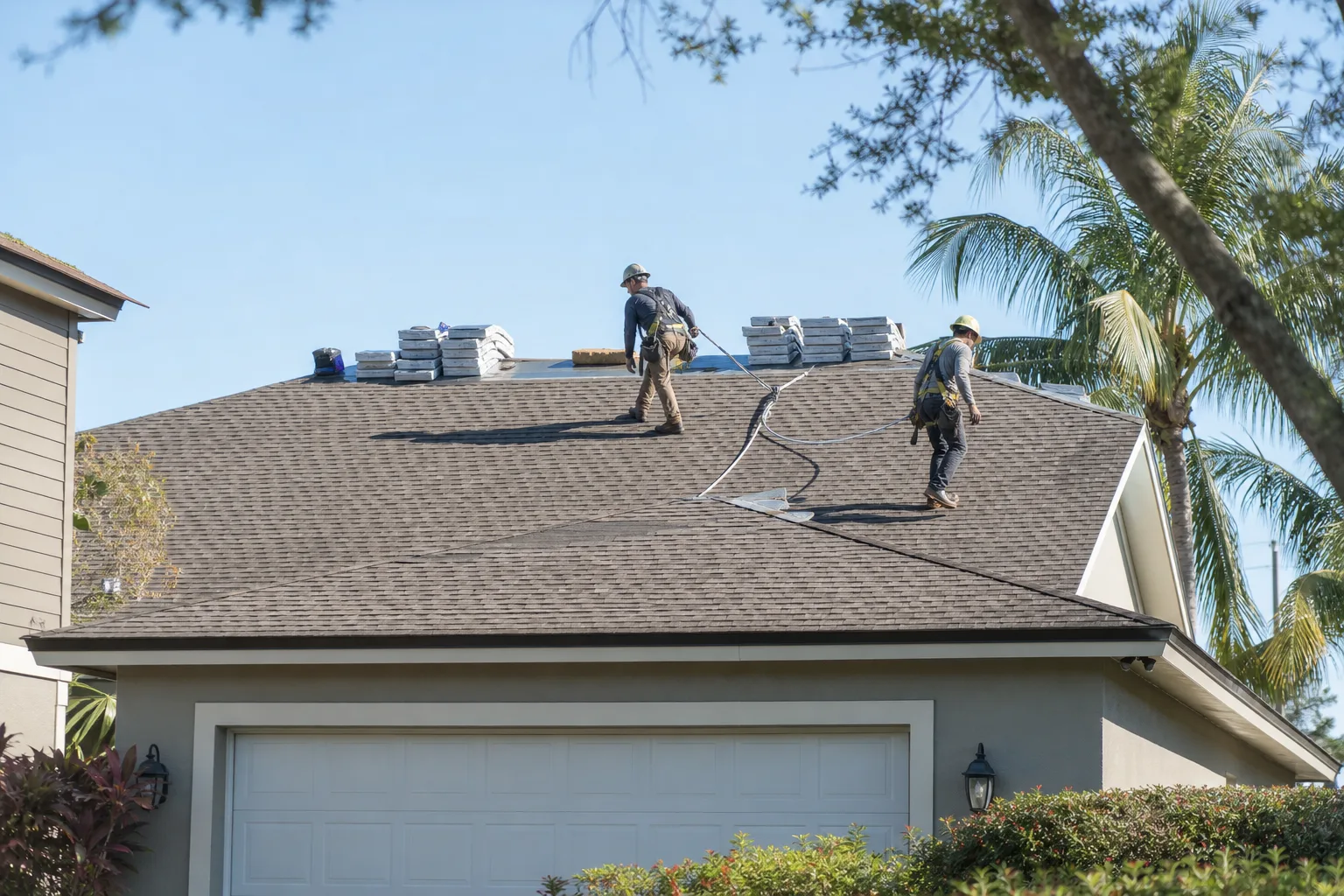
Not necessarily, and on a pitched roof it’s usually smarter not to. You can do the entire diagnostic from the ground and the attic side – trace the stain, inspect the flashing visually, run the hose test with a helper – without stepping onto a wet, slanted roof. Climbing a wet roof during or just after a rain event is how homeowners get hurt; that’s a job for trained, insured technicians. If the flashing is high or the pitch is steep, stay off it.
Why does the leak show up far from where the roof looks damaged?
Because water follows the decking and framing before it finds an opening. Once water gets under a membrane or behind stucco, it travels laterally – sometimes six to eight feet – and only drips where a nail hole or seam gives it a path. That’s why “the stain is above the living room, so the hole must be above the living room” almost never holds on older Long Beach roofs. Always work uphill from the drip.
When to Call a Pro During the Storm
Some leaks you can trace on a dry Saturday. Others only reveal themselves mid-rain, and that’s the wrong time to be climbing a ladder. Groundwork Construction Co. of Long Beach answers calls with a live person 24/7 – no voicemail, no waiting until Monday morning – so you can call during the actual rain event and walk through a real-time diagnostic with someone who knows what they’re hearing. That matters here because a ceiling that’s been absorbing water for three more hours before help arrives is a bigger repair than one caught early. Our technicians have up to 12 years of experience with exactly this housing stock, and every job is backed by our 730-Day Done Right Promise – if it’s not done right, we make it right.
Roof Repair and Replacement Costs in Long Beach
Once you’ve found the leak, the repair cost depends on what failed. A single flashing repair is a very different bill from a failing roof, so here are the Long Beach ranges so you can budget before anyone gets on the roof. All work is priced upfront, and we stand behind it in writing.
| Job | Typical Range |
|---|---|
| Roof repair (single leak / flashing) | $400-$1,800 |
| Tile roof repair | $600-$2,500 |
| Full roof replacement | $8,000-$20,000 |
| Metal roof installation | $15,000-$40,000 |
When a repair turns into a replacement, we install systems from GAF, CertainTeed, and Owens Corning, matched to a coastal environment that punishes cheap fasteners. For a deeper look at what a full replacement involves, see our Roofing page, and for local project details, browse the Long Beach service area.
FAQs About Finding a Roof Leak
Mark the drip point with tape, then trace the water uphill along the ceiling and roof slope rather than straight above the stain. Look for the entry at flashing joints, stucco-to-roof transitions, and any addition seam, since water travels several feet before it drips. If you can safely reach the attic, check the decking for wet wood as a cross-reference, not a substitute for the uphill trace.
Corroded step flashing at chimney and dormer bases is the most frequent hidden culprit on homes built before 1970, because salt air eats galvanized metal fast. The flashing rusts through, water slips behind the stucco, and the stain shows up inside well away from the roof. Check the metal first. If you’d rather have it looked at, call (888) 345-8164 for a free estimate.
Yes. Termite galleries in the roof decking create paths for water movement through condensation and capillary action that look like an active leak, but they don’t come from a surface breach. Put a moisture meter on the decking to distinguish the two before you start removing shingles. If you’d rather have it looked at, call (888) 345-8164 for a free estimate.
Most Long Beach roof repairs run $400-$1,800, while tile roof repair runs $600-$2,500, and a full replacement ranges from $8,000-$20,000. The exact number depends on what failed: a flashing repair is far cheaper than a failing membrane. Call (888) 345-8164 for an exact quote – estimates are free and pricing is upfront, nothing hidden.
Get It Looked At Before the Next Rain
A slow ceiling stain is your best chance to fix a leak cheaply. We’ll trace the source, give you upfront pricing, and back the work with our 730-Day Done Right Promise. Financing at 0% for 18 months and $1,000 off projects over $10,000 are available. For a no-pressure home assessment in Long Beach, call (888) 345-8164.
Written by the team at Groundwork Construction Co. of Long Beach, serving Long Beach, CA.


